Laptops and tablets
Note how many devices, their overall size and thickness, where chargers go, and whether each unit needs its own slot.
Shop multiple laptop casesitems

Protective case sizing guide
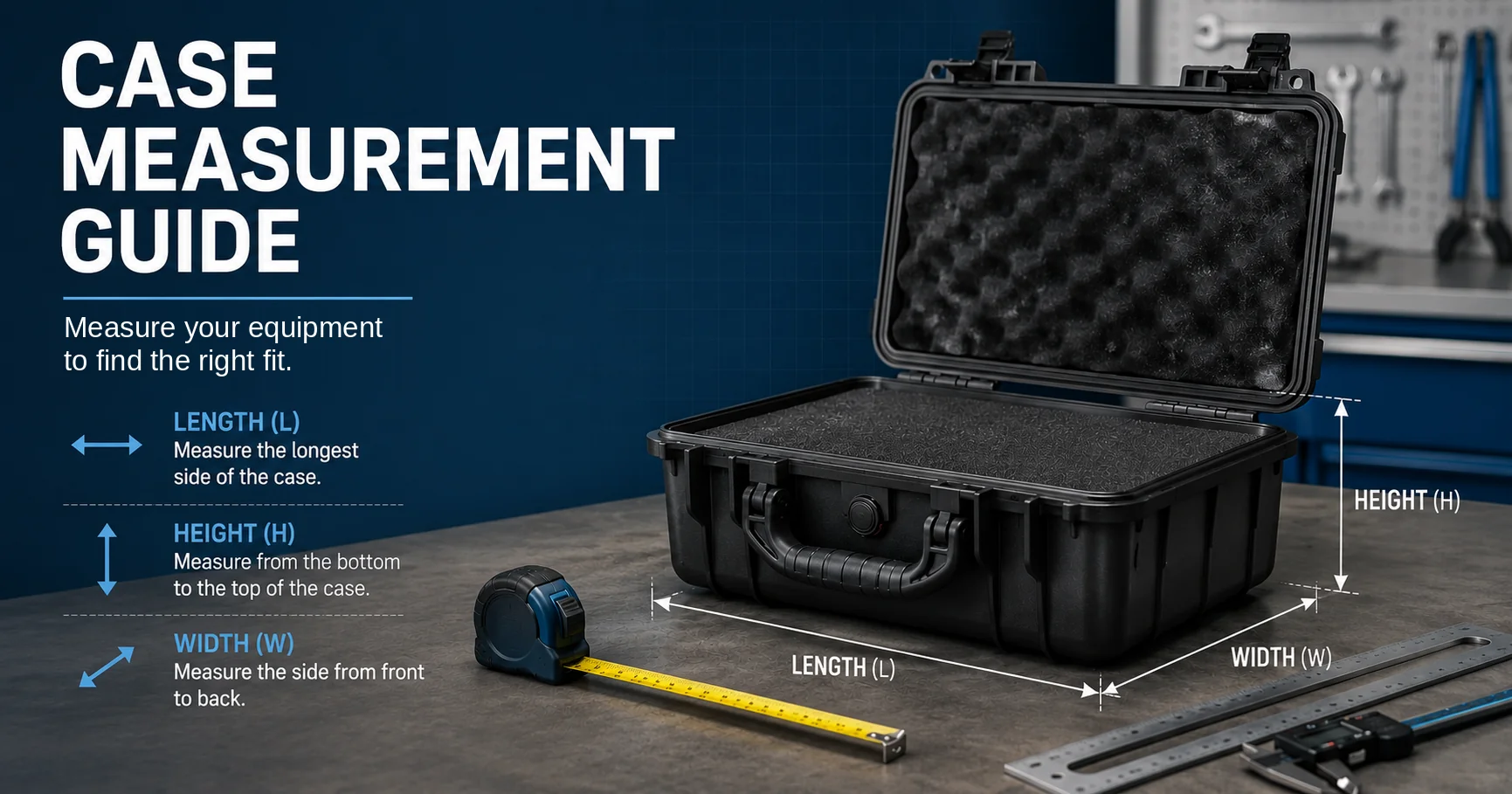
Measure the equipment itself, include every protrusion and accessory, and allow room for foam, dividers, cables, lids, and rails. Accurate dimensions make it easier to choose the right stock or custom case.
Before you start
At the largest points, in the way the item will sit in the case.
Knobs, feet, handles, brackets, and connectors.
Chargers, cables, tools, and spare parts.
Total loaded weight, and hand carry, vehicle, parcel, freight, or air.
Quick answer
Record the equipment’s maximum length, width, and height in the position it will sit in the case. Include handles, knobs, feet, brackets, ports, connectors, and mounted parts.
Minimum interior dimension = equipment dimension + clearance on both sides.
For example, equipment measuring 18 × 12 × 6 inches with 2 inches of protection on every side starts at about 22 × 16 × 10 inches of usable interior space. Final clearance depends on the equipment’s weight and fragility, the foam type, and how the case is handled.
Step-by-step guide
Follow these six steps before shopping, using a case finder, or requesting a quote.
Decide how the equipment will sit inside the case before you assign length, width, and height.
Measure at the widest, deepest, and tallest points, including anything that sticks out or is attached.
Allow room for foam, dividers, padding, lid depth, cable clearance, and loading access.
List chargers, cables, tools, batteries, brackets, remotes, adapters, documents, and spare parts.
Add the case, equipment, accessories, and interior together to plan handles, wheels, and shipping.
Interior dimensions decide the fit. Exterior dimensions affect storage, vehicles, freight, and handling.
Fit checklist
Sizing by equipment type
Each type of equipment has fit details beyond basic length, width, and height.
Note how many devices, their overall size and thickness, where chargers go, and whether each unit needs its own slot.
Shop multiple laptop casesConfirm rack units, server depth, rail and handle projection, rear cable clearance, and whether it ships mounted.
Shop server casesConfirm rack units, mounting depth, front and rear clearance, cable bend space, shock protection, and loaded weight.
Shop rack casesUse the full monitor width, height, and depth, not only the diagonal screen size. Include stands, mounts, handles, and cables.
Shop flat screen casesMeasure the full footprint, height, accessories, and protection clearance. Consider wheels, handles, and stacking.
Shop shipping casesMeasure every item and note spacing, the order things come out, accessory compartments, and fragile points.
Compare interior optionsDimension definitions
These measurements answer different questions. Checking all of them helps you avoid a fit that works on paper but not in practice.
| Measurement | What it means | Why it matters |
|---|---|---|
| Equipment dimensions | Maximum outside length, width, and height of the item. | The starting size before you add protection clearance. |
| Interior dimensions | Inside length, width, and height of the empty case. | Shows whether the equipment and its interior can fit. |
| Usable space | The space left after foam, dividers, lid depth, rails, and padding. | Keeps you from choosing a case that’s too tight once protection is added. |
| Exterior dimensions | Overall case size, including shell, hardware, wheels, and handles. | Affects storage, vehicles, parcel limits, freight cost, and handling. |
Avoid fit problems
Diagonal screen size leaves out the bezel, stand, housing, hinges, and depth.
Chargers, cables, brackets, tools, adapters, and removable parts often need their own space.
Matching the interior exactly to the equipment leaves no room for cushioning or loading.
The outside of the case still has to fit storage areas, vehicles, doorways, and parcel limits.
Experience and accountability
We compare fit by equipment, handling environment, transport method, and workflow.
We check available stock sizes before deciding whether a custom case is needed.
Specialty Cases has helped organizations choose reusable protective cases for over 35 years.
Guidance owner: Specialty Cases case specialists · Last reviewed August 2026
FAQs
Measure the equipment whenever possible. An old case may include unused space, compressed foam, or an interior layout that no longer fits how you use it.
It depends on the equipment’s weight, fragility, and shape, how it travels, and the foam you choose. Use the starting calculation above for planning, then confirm the final allowance with us before ordering.
No. Screen size is measured diagonally and doesn’t include the bezel, housing, hinge, stand, depth, or attached accessories. Measure the full outside dimensions.
Send the rack units, equipment and mounting depth, front and rear cable clearance, total loaded weight, how it travels, and any needs for shock protection, wheels, lids, or console access.
Send your dimensions, quantity, loaded weight, accessories, how the cases will travel, your interior preference, and photos if you have them.
Tell us what you’re trying to protect (dimensions, weight, use-case) and we’ll help you pick the right case.
Checking availability…
Would you like us to check stock for a specific case?
Send the product and quantity. We’ll confirm availability, lead time, and practical alternatives.
Send a message and our team will follow up by email.